Close Encounters of a Localization Kind: Subbing and Dubbing a Comedy Sketch into your Second Language
Copyright Disclaimer: under section 107 of the Copyright Act of 1976, allowance is made for “fair use” for purposes such as criticism, comment, news reporting, teaching, scholarship, education, and research. This project is a proof-of-concept, and as such does not represent nor infringe on the creator(s) in any way.
First Contact: A Comic Sighting (Introduction)
In my academic and professional career, I was told that the hardest and rarest thing to translate was something similar to a translator’s skill in the sense that you either have the knack for it or you don’t: comedy. I personally love comedy: I grew up watching movies like Police Academy and The Wedding Singer and have fond memories of watching Saturday Night Live (SNL) on Sundays after it aired every weekend of middle school and high school. So when I was given the chance to try my hand at audiovisual localization, I knew exactly what I wanted and needed to do.
Comedy is not something commonly taught in translation classes, but it is something that I experienced often when learning a language through movies, skits, and TV shows. I learned how to translate imagery and literature, but making something funny was a totally different experience. One could even say it was almost otherworldly to attempt translating comedy. Yet when I saw the strange lights of comedy appearing in the sky, I had no choice but to follow my curiosity.
Second Contact: A Humorous Plan (The Project)
Working with my colleagues Dayna Brown (she/her/hers) and Nicolas Niculescu (he/him/his), I had the opportunity to translate, dub, subtitle, and edit the SNL skit “Close Encounters” where three recent alien abductees are interviewed about their experience by two NSA agents. Two of the characters have an enlightening positive experience while the other has a strange, humorous encounter. Much of the comedy arises from this different experience because of how frank and crude the character speaks compared to the other characters and their reactions to her experience. I translated the skit into Spanish while Nick and Dayna translated it into Japanese and Chinese respectively.
The first challenge I faced in translating was how to distinguish characters from one another since my voice is naturally pretty feminine and higher pitched and there were 2 male characters. I tried to circumvent this by using different dialects and registers of Spanish for each character, but in the end, they may not sound very different. Secondly, I struggled to know how to translate her rather vulgar terminology into a different language. The words she used are specific and easily-understood in English but cannot be translated literally into Spanish. Luckily, I was able to find a good amount of Spanish-speaking websites where people compared terms and found what I needed.
The original English video. If the video does not load: link here.
Third Contact: Deciphering the Language (The Workflow)
Below is an infographic of the workflow tips I would recommend for someone translating comedy followed by the actual workflow I followed for the project.
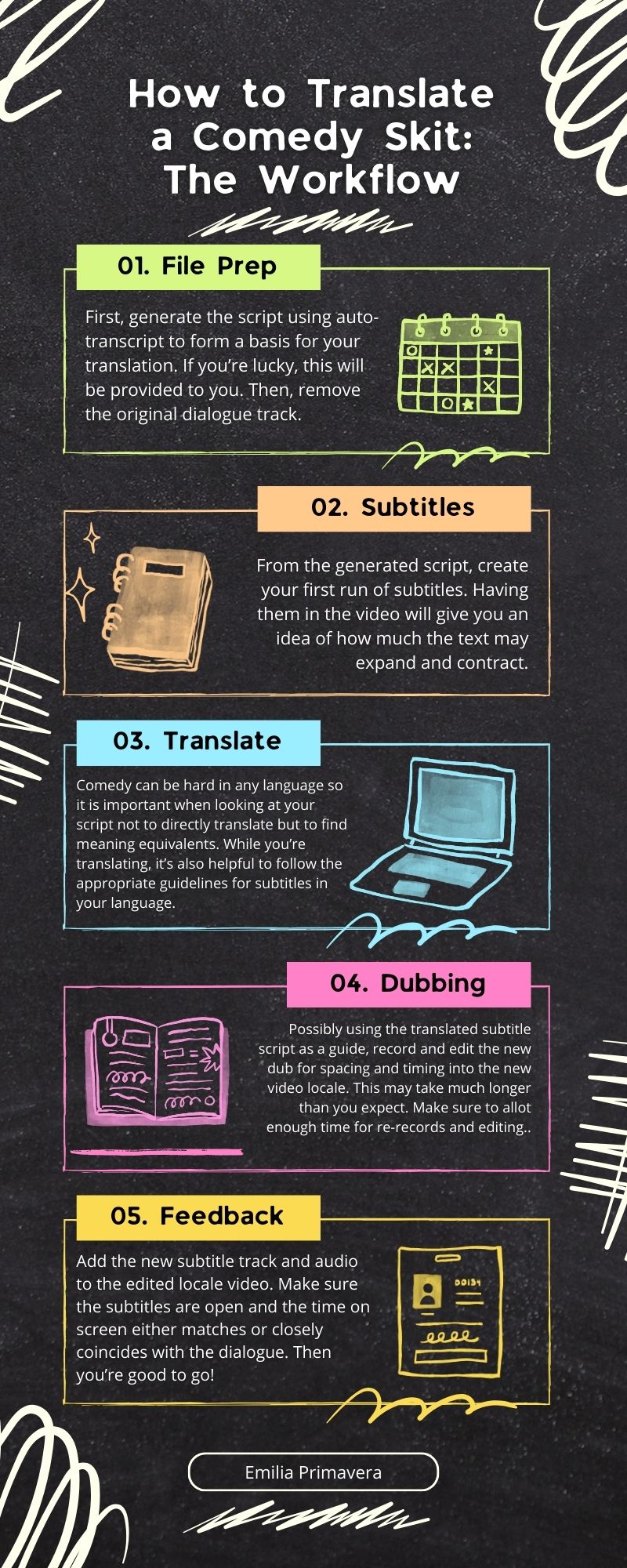
- Create the English transcript in Adobe Premiere Pro – Nick
- QA the English Source transcript for accuracy and flag potential areas of localization difficulties. -Nick, Dayna, Emilia
- Remove dialogue from the original clip – Emilia
- Translate & transcreate English script
- Into Spanish (Emilia)
- Into Simplified Chinese (Dayna)
- Into Japanese (Nick)
- Post edit the transcript for each respective language and make adjustments for time limitations of subtitles and the target language dub. -Nick, Dayna, Emilia
- Create 5 unique voices for each of the 5 characters in the skit per language.
- Create subtitles for all languages (Emilia – Spanish subtitles; Dayna – Chinese subtitles; Nick – Japanese subtitles) and edit for timing and legibility in each language.
- Record in Audition the dub for each target language.
- Emilia- Spanish, Dayna – Chinese, Nick – Japanese, we will be voicing all the characters for the given language.
- Reformat the video and add in laugh tracks relevantly timed to the target language dub.
- Create final versions of the dubbed and subtitled Chinese video, the Spanish video, and the Japanese video.
For dubbing, we used Adobe Audition; Adobe Premiere Pro, Caption Hub and memoQ for subtitling; and Adobe Premiere Pro once more for editing.
Fourth Contact: Phoning the Comedy UFO (Lessons Learned and Conclusion)
When I entered this project, I expected dubbing to be the easiest thing to do: however, this ended up being the most painstaking and long process of the whole workflow. Since I was dubbing all 5 characters, the timing I needed to have to change my voice/accent while also fitting all the dialogue into the allotted time multiplied significantly than if I were to have pre-recorded dialogue I simply needed to add and adjust. So what I thought would take an hour actually took around 3 hours spread across multiple days.
Another struggle of mine was trying to align to industry-accepted subtitle guidelines. For Spanish, the length of the translation expands up to 20-25% compared to the English and many times the verb I needed to use as a result was much longer. Following the subtitle guidelines set by Netflix for Spanish meant that I had to either choose different words or completely omit information from the subtitles to meet both character limits and character reading speed per second. In the end, some of my subtitles simply had to not meet guidelines for reading speed because there was truly no other way to translate.
Even with these issues, the project was an amazing experience and I was very happy that I could try my hand at comedy translation. I now have a better grasp on why timelines for audiovisual localization of an asset usually take 2 weeks. I couldn’t imagine what this would be like for a one-person team so I am very thankful to my diligent and reliable colleagues for taking over the other locales for me. I had an excellent time working with them.